While this probably isn't my most exciting post, it is informative and will help to understand a much more exciting post that I've been working on for later in the week.
With all the hubbub about Supreme Court nominees lately, I think it would be useful to speak for a moment about judicial philosophy as it relates to Constitutional law. In my class on that very subject, we learned on the first day that there are seven primary methods of constitutional interpretation.
1. Textual
2. Original Understanding
3. Ongoing History
4. Doctrinal/Precedential
5. Structural
6. Ethics/Values
7. International Practices
Textual interpretation involves looking at only the words in the text of the Constitution. Since we all know that words have no set meaning, this clearly can’t stand alone. So Justice Scalia (among others) moves on to the second, which asks the question, “What did they mean when they wrote that text?” The ongoing history (or evolving Constitution) method looks at the Constitution as a document that changes to meet the needs of the present. The doctrinal method looks at prior cases from the Court and attempts to apply the principles in those cases to the present one. The structural method looks at the whole document and tries to find overarching principles in that document and the functions that it has put into place. The ethics approach looks not only at the document itself, but also at the values contained within, and is inextricably related to the ongoing history method. And the international practices approach, while not fully accepted, looks at what other nations have done and reads the text in light of international experience.
Where am I going with this? The answer is this: I like the first, second, fourth, and fifth methods because they keep the balance in the checks and balances and the separation in the separation of powers. They respect the intent of the people who wrote and enacted the Constitution. I don’t like the third, sixth, and seventh methods at all. And the reason is that they evidence a lack of faith in the democratic process that overarches the whole Constitution.
How would you like it if, after you die, the judge looked at your will and, instead of trying to do what you wanted, he did what he thought was fair?
These (questionable) methods are based on a few lines in the Constitution. The Ninth Amendment reads: “The enumeration in the Constitution, of certain rights, shall not be construed to deny or disparage others retained by the people.” The Tenth Amendment reads: “The powers not delegated to the United States by the Constitution, nor prohibited by it to the States, are reserved to the States respectively or to the people.” And § 1 of the Fourteenth Amendment reads, in part, “No State shall make or enforce any law which shall abridge the privileges or immunities of citizens of the United States; nor shall any State deprive any person of life, liberty, or property, without due process of law; nor deny to any person within its jurisdiction the equal protection of the laws.”
If you wanted to look at the original understanding of the 9th and 10th, as I would suggest, you would know that they were intended to limit the power of the federal government and retain power in the states. But some justices like to look at the phrases “other[ rights] retained by the people,” the rights “reserved . . . to the people,” and “the privileges or immunities of citizens” and extrapolate new rights, not written into the Constitution or intended by the people who wrote it, thereby expanding the power of the federal judiciary.
This concept, known as substantive due process, is used to put power in the hands of the unelected judges so they can put their own policies into place. How do they explain it? Well, Justice Douglas (the bastard), in Griswold v. Connecticut, said it this way: “[S]pecific guarantees in the Bill of Rights have penumbras, formed by emanations from those guarantees that help give them life and substance.” That’s right. He thinks there are penumbras surrounding the rights, and that said penumbras are apparently emanating in such a way as to let the justices of the Supreme Court to do whatever they want.
They use this to strike down laws they don’t like, such as those that prohibit the use of contraceptives or abortion.
When people accept these methods, they accept rule by philosopher kings rather than by democracy.
My lack of faith in this method of constitutional interpretation knows no bounds. Many people find themselves unable to say that the Court shouldn’t strike down anti-contraceptive laws, or other equally silly and unpopular laws. However, I say this is none of the Court’s business. As the dissenters in Griswold pointed out, the Framers of the Constitution allowed for change within the document, through the process of amendment. They didn’t entrust this to the judiciary. And the political and democratic processes will solve all the problems the Court sees, given time. And when it does, people won’t be pissed at the Court for it. The Court is unaccountable, and shouldn’t be making any kinds of policy decisions.
Of course, it’s different when a law infringes on free speech, free exercise of religion, or the rights of the criminal accused. These rights are already protected, and the 14th Amendment applies those same restrictions to the states. But if we really want the Court to be doing what it does every single term, then I suggest we enact the following amendment:
“The rights protected in the Constitution shall be construed to have penumbras, formed by the emanations from these rights, so that those guarantees will have life and substance.”
Monday, November 07, 2005

Friday, November 04, 2005
The Return of Eternal Twilight
OMFG!!!!11eleven!!!
They're apparently back! I posted on them previously, thinking they were gone forever, but we are in luck!
Buy this thong!
Yes! Eternal Twilight, the "Shadow Gods of the New Age," are still around. (And are apparently looking for a new bass player as well as a drummer.)

You can even listen to them! (Actually, they're worse than I remember.) They even have a new album, Eat the Weak.
According to their website, "Fantasy and reality, sanity and madness, light and shadow. We live in the place between dreaming and awakening, in the eternal now. We have escaped the prison."

And, according to RockKansas.com, "Eternal Twilight draws from ancient shamanism, sci-fi and horror to create a memorable concert and album experience. The band uses masks and costuming to become avatars of the gods." You read that right. They become avatars of the gods. Also, check out this link, because apparently the University of Nebraska's own Tommy Lee called them "scary."
By the way, Lucifer has changed his name to "Samuel Morningstar." You can reach him at (913)980-7775 on the phone,morningstar72@comcast.net on the old e-mail machine, or for their snail-mail address:
Eternal Twilight
13505 S Mur-len
Olathe, KS 66062
Three 6's in their zip code . . . coincidence? I think not!
Edit: more pictures!


They're apparently back! I posted on them previously, thinking they were gone forever, but we are in luck!
Buy this thong!
Yes! Eternal Twilight, the "Shadow Gods of the New Age," are still around. (And are apparently looking for a new bass player as well as a drummer.)
You can even listen to them! (Actually, they're worse than I remember.) They even have a new album, Eat the Weak.
According to their website, "Fantasy and reality, sanity and madness, light and shadow. We live in the place between dreaming and awakening, in the eternal now. We have escaped the prison."

And, according to RockKansas.com, "Eternal Twilight draws from ancient shamanism, sci-fi and horror to create a memorable concert and album experience. The band uses masks and costuming to become avatars of the gods." You read that right. They become avatars of the gods. Also, check out this link, because apparently the University of Nebraska's own Tommy Lee called them "scary."
By the way, Lucifer has changed his name to "Samuel Morningstar." You can reach him at (913)980-7775 on the phone,
Eternal Twilight
13505 S Mur-len
Olathe, KS 66062
Three 6's in their zip code . . . coincidence? I think not!
Edit: more pictures!


Stay away from Meth
This past weekend I stopped at a gas station. While standing in line, I witnessed very odd behavior from the man in front of me. He was wearing blue sweatpants and had a lot of change in his pocket. Classic rock music was playing on the radio and this guy couldn't sit still. He was rocking back and forth and tapping the change in his pocket in tune with the music. At first I thought he was maybe a mentally handicapped person who really loves classic rock, because he was really getting into it without any regard for the possibility that people may be staring at him. This continued until he was at the counter, at which point he dumped out at least five dollars in change on the counter, and, while counting it out, he rocked back and forth wildly. It was kind of like an exaggerated impression of a six-year-old who has to go to the bathroom. After paying, he scooped up the change and left in quite a hurry.
The lesson is, kids, stay away from meth. It makes you act like a total jackass. (And let's not forget the other things, like losing all your teeth.)
In an unrelated event, this past winter we had a fairly substantial blizzard. In the news was a story about two people who got stranded. Instead of waiting in their vehicle for help, or using their cell phone (which they had) they got out and went looking for help. When you're on meth, it doesn't make any sense to stand still. They called for help, eventually. They told the 911 operator that they had just found a shelter, but there were a bunch of people on the roof. They went into the shelter. The 911 operator asked them if they were on meth, informing them that they would not be punished if they were. They hung up, and were found later frozen to death, obviously not in the shelter (or they would have survived).
Yeah, let's not forget about dying. That's another side effect.
I don't know why I chose to write about this today. I just thought about it, and I can't get over how bad that stuff is. I doubt anyone who visits this site is on meth (hell, you wouldn't be able to sit still long enough to read it). Just stay away from it. And if you suspect anyone of making it, report it. It's probably more dangerous than someone selling handguns illegally.
Griswold v. Connecticut, 381 U.S. 479
The case concerns a Connecticut law outlawing the use of contraceptives.
The Court struck down the law on the basis of their newly discovered right to privacy.
 Justice Black dissented: “I do not to any extent whatever base my view that this Connecticut law is constitutional on a belief that the law is wise or that its policy is a good one. . . . There is no single one of the graphic and eloquent strictures and criticisms fired at the policy of this Connecticut law either by the Court’s opinion or by those of my concurring Brethren to which I cannot subscribe—except their conclusion that the evil qualities they see in the law make it unconstitutional. . . . The Constitution makers knew the need for change and provided for it. Amendments suggested by the people’s elected representatives can be submitted to the people or their selected agents for ratification. . . . I cannot rely on the Due Process Clause or the Ninth Amendment or any mysterious and uncertain natural law concept as a reason for striking down this state law.”
 Justice Stewart also dissented: “I think this is an uncommonly silly law. As a practical matter, the law is obviously unenforceable . . . . As a philosophical matter, I believe the use of contraceptives in the relationship of marriage should be left to personal and private choice . . . . But we are not asked in this case to say whether we think this law is unwise, or even asinine. We are asked to hold that it violates the United States Constitution. And that I cannot do.”
Thursday, November 03, 2005
Pluralism: The Solution to the ID Debate?
Copernicus Now has written an extremely interesting allegory about the “conflict” between religion and science. (Okay, maybe it’s a metaphor. Stop splitting hairs.) I suggest you read it, lest ye become one of the unwashed barbarians (or paranoid peasants) of which he speaks.
Instead of discussing the relative merits of evolution and intelligent design, today I’m going to take a more pragmatic approach.
At my undergraduate university, I took a class called “The Gospel in a Pluralistic World.” (Well, I didn’t so much take it as I stopped showing up after three weeks and then dropped it on the last possible day.) Anyway, that class was about addressing the different ideologies that Christians can encounter in a productive way. And in my short time there, pluralism was a four-letter word. (No, they didn’t spell it prsm, or plsm, or plrm. You know what I meant.) This is because pluralism was seen as an attempt to accept all points of view, and if you’ve read the Bible (especially the first chapter of Ezekiel and the 28th Chapter of Matthew) you know that it is the Christian’s duty to present God’s Word in the hopes that everyone will accept it. Along with pluralism, in the eyes of some academics, comes relativism.
Also, pluralism was equated with a common understanding of tolerance, that all points of view are to be embraced unless those views are intolerant of other views, or they are absolutist. But I’ve realized (probably partly due to a South Park episode and Philosophy 201) that tolerance should mean purely a pragmatic acceptance of all views (as opposed to an academic acceptance), with the caveat that we are free not to embrace those views with which we don’t agree, and even to criticize those views. (In the future I’ll try to avoid sentences with 7 or more phrases embedded within them.)
This brings me up to yesterday. I attended a lecture on the ID debate. It was excellent. He went through the history of the Bible’s relationship to public schools. A couple of things became clear. One, that religion as we know it in the US is not anti-science, or anti-intellectual, but instead anti-elitist. From that we can understand that historically religion is not opposed to the teaching of evolution, but instead it wants its side of the story presented as well. Two, the traditional debate about the Bible’s relationship to public schools was never about Christians versus non-Christians, but instead about Protestants versus Catholics, and it goes back as far as the 1830’s or 40’s. The conflict between these two groups is based on the former’s reliance on the Bible as authority and the latter’s reliance on earthly leaders (i.e. the Pope) as authority. And three, that ID is just the latest controversy in this ongoing debate that will likely never end.
The class would go over the very basics of epistemology. Addressing Parmenides would make an excellent introduction to the class, and would make the kids more likely to listen and open to different suggestions. It would discuss popular epistemological traditions such as revelation, reason, and, of course, the scientific method. The course would promote pluralism and would hopefully make everyone happy.
In my world, it would be a required class in order to graduate.
Basically, the reasoning behind this is that science, while extremely important in our society, is not the only way to know. It gets put up on a pedestal while other epistemological methods are scoffed at. There is no good reason for this state of affairs. (Of course, maybe I’m biased because of my belief in a liberal arts education.)
This idea is not susceptible to the slippery-slope problem that FSM points out in ID. Plus, it has the added bonus of being pretty much impervious to legal attack (quite unlike ID, which, were it ever to come before the Supreme Court, would likely be struck down).
There may be problems with my proposed solution. Introducing these kinds of questions could undermine the atmosphere of authority that teachers and administrators need to keep control in the classrooms. If you introduce it at a middle school level, the children may not be capable of grasping the concepts. If you introduce it to high school seniors, many dropouts won’t ever get to hear it and the kids may already have an unquestioned acceptance of certain views (and also, everyone knows that senioritis can seriously interfere with learning).
Despite these problems (and any others I may have missed), it’s still a worthy proposal. And I definitely believe it to be important enough to be a graduating requirement. Isn’t it certainly at least as important as social studies? Or a year of history? Or reducing the kids’ options to take one of their many elective courses? Or a year of English when the students take an English class every year from kindergarten through the 12th grade?
Certainly, the question “How do we know what we know?” has been the mort important question for all philosophers since the beginning of that great tradition. Could they all be wrong?
Instead of discussing the relative merits of evolution and intelligent design, today I’m going to take a more pragmatic approach.
At my undergraduate university, I took a class called “The Gospel in a Pluralistic World.” (Well, I didn’t so much take it as I stopped showing up after three weeks and then dropped it on the last possible day.) Anyway, that class was about addressing the different ideologies that Christians can encounter in a productive way. And in my short time there, pluralism was a four-letter word. (No, they didn’t spell it prsm, or plsm, or plrm. You know what I meant.) This is because pluralism was seen as an attempt to accept all points of view, and if you’ve read the Bible (especially the first chapter of Ezekiel and the 28th Chapter of Matthew) you know that it is the Christian’s duty to present God’s Word in the hopes that everyone will accept it. Along with pluralism, in the eyes of some academics, comes relativism.
Also, pluralism was equated with a common understanding of tolerance, that all points of view are to be embraced unless those views are intolerant of other views, or they are absolutist. But I’ve realized (probably partly due to a South Park episode and Philosophy 201) that tolerance should mean purely a pragmatic acceptance of all views (as opposed to an academic acceptance), with the caveat that we are free not to embrace those views with which we don’t agree, and even to criticize those views. (In the future I’ll try to avoid sentences with 7 or more phrases embedded within them.)
This brings me up to yesterday. I attended a lecture on the ID debate. It was excellent. He went through the history of the Bible’s relationship to public schools. A couple of things became clear. One, that religion as we know it in the US is not anti-science, or anti-intellectual, but instead anti-elitist. From that we can understand that historically religion is not opposed to the teaching of evolution, but instead it wants its side of the story presented as well. Two, the traditional debate about the Bible’s relationship to public schools was never about Christians versus non-Christians, but instead about Protestants versus Catholics, and it goes back as far as the 1830’s or 40’s. The conflict between these two groups is based on the former’s reliance on the Bible as authority and the latter’s reliance on earthly leaders (i.e. the Pope) as authority. And three, that ID is just the latest controversy in this ongoing debate that will likely never end.
Proposal
So that brings me up to the lecturer’s suggestion. He implied that ID should be disregarded altogether. He also implied that ID (or any variant formulation thereof) should stay out of the science classrooms. However, he would have a sort of epistemology class offered. Call it introductory philosophy if you will. He didn’t go into much detail on it, but here’s how I would do it.The class would go over the very basics of epistemology. Addressing Parmenides would make an excellent introduction to the class, and would make the kids more likely to listen and open to different suggestions. It would discuss popular epistemological traditions such as revelation, reason, and, of course, the scientific method. The course would promote pluralism and would hopefully make everyone happy.
In my world, it would be a required class in order to graduate.
Basically, the reasoning behind this is that science, while extremely important in our society, is not the only way to know. It gets put up on a pedestal while other epistemological methods are scoffed at. There is no good reason for this state of affairs. (Of course, maybe I’m biased because of my belief in a liberal arts education.)
This idea is not susceptible to the slippery-slope problem that FSM points out in ID. Plus, it has the added bonus of being pretty much impervious to legal attack (quite unlike ID, which, were it ever to come before the Supreme Court, would likely be struck down).
There may be problems with my proposed solution. Introducing these kinds of questions could undermine the atmosphere of authority that teachers and administrators need to keep control in the classrooms. If you introduce it at a middle school level, the children may not be capable of grasping the concepts. If you introduce it to high school seniors, many dropouts won’t ever get to hear it and the kids may already have an unquestioned acceptance of certain views (and also, everyone knows that senioritis can seriously interfere with learning).
Despite these problems (and any others I may have missed), it’s still a worthy proposal. And I definitely believe it to be important enough to be a graduating requirement. Isn’t it certainly at least as important as social studies? Or a year of history? Or reducing the kids’ options to take one of their many elective courses? Or a year of English when the students take an English class every year from kindergarten through the 12th grade?
Certainly, the question “How do we know what we know?” has been the mort important question for all philosophers since the beginning of that great tradition. Could they all be wrong?
Wednesday, November 02, 2005
Pirate Name
My pirate name is Bloody Harry Kidd.
Every pirate lives for something different. For some, it's the open sea. For others (the masochists), it's the food. For you, it's definitely the fighting. Even though you're not always the traditional swaggering gallant, your steadiness and planning make you a fine, reliable pirate. Arr!
Someone said this was messing with another post, so I've taken out all the excess code.
Get your own pirate name from fidius.org.
Holy Crap
A man killed an intruder at home. Normally this wouldn't be big news. But the identity of the intruder can make it news.

He also probably fights animated statues, Lachupacabra, hordes of ninja, and other nasty things with nothing but his kinfe.
For 40 exhausting minutes, Wayne Goldsberry battled a buck with his bare hands in his daughter's bedroom.Found it here. That's right. The guy killed a deer with his bare hands. My guess is, the guy looks something like this:
Goldsberry finally subdued the five-point whitetail deer that crashed through a bedroom window at his daughter's home Friday. When it was over, blood splattered the walls and the deer lay dead on the bedroom floor, its neck broken.
He also probably fights animated statues, Lachupacabra, hordes of ninja, and other nasty things with nothing but his kinfe.
Throat Slashing

Here is one of many articles about the recent controversy surrounding Nebraska's head footbal coach Callahan. In case you haven't heard, here's the problem:
Nebraska coach Bill Callahan said Monday that he didn't make a throat-slashing gesture toward an official after Oklahoma scored a touchdown Saturday.And that's the way everyone is writing the story. They say he denied making the gesture. But here's another problem:
Videotape showed Callahan raising his right arm, index finger extended, and making a motion from left to right across his throat.Sounds like a throat slash gesture to me. But it doesn't sound like Callahan actually denied making the gesture, as all the reporters would have you believe:
Callahan said, "Oh, no. No. I was frustrated and emotional. There was no malicious intent toward anyone or any referee."It sounds to me like he just didn't mean anything by it. As in, he didn't actually intend it as a death threat. It certainly couldn't mean that the gesture wasn't directed at anyone. You don't just throat slash in a vacuum, just like you don't extend your middle finger generally. It's always directed at someone. Of course, there is an alternative, unlikely explanation:
Callahan declined to comment on whether he intended the slashing motion to be a demonstration of how cornerback Cortney Grixby was held on the play.Good call on that, because I don't think anyone would believe you.
But what's the big deal, really? I think of the movie 12 Angry Men with this situation. How many times do you make what could be construed as a death threat without actually meaning it? "I'm gonna kill you!" could just mean "I'm really pissed and I'm gonna spank you and send you to bed early."
The article also says that the NCAA has classified the gesture as unsportsmanlike conduct, and it should result in a 15-yard penalty. They didn't give the team a penalty (just like they didn't give OU a holding penalty). So, should it be just as big a deal any time someone does pass interference (another 15-yard penalty) and it doesn't get called? It's really not a big deal, even if it was really stupid for Callahan to make the gesture. In the end, the coach said it best:
"Someone is making a big deal out of something that's nothing," Callahan said. "I really don't know what you're talking about."
Edit: in other, completely unrelated NCAA news, there's this picture:

If you have to ask why this is funny, you don't want to know.
Tuesday, November 01, 2005
Parking: American Neuroticism
Every culture, I suppose, has its neuroticisms. Korea, for example, is probably the most neurotic area in the world. I learned much of this through The Shaved Ape Chronicles, but also from other sources. In the South, they’re obsessed with video games. A few men have died after gaming binges through which they don’t eat or sleep or practice even a primitive caveman form of hygiene. Their government estimates that over 30% of their population is addicted to video games (I can’t remember if that’s 30% of all or just the males). Some form real-life gangs to exact violent revenge on people who mess with them in online games. In the North, they believe the most bizarre claims of their government, like when Kim Jong Il played his first ever game of golf and got a hole-in-one on over half of the holes. (I’m not really sure if that qualifies as neurotic, but it’s crazy nonetheless.)
I’m not too well-versed in the insanity of other countries, aside from religious or political nuttitude that ends up killing people in places like Arabia, Ireland, East Europe, and other places.
In America, we have parking spots. But not just any parking spots. Oh, no. In America, only the best gets our attention. The best parking spots make us go crazy. The closest spot is like freakin’ nirvana, but with more beer and pizza (and without the mediocre grunge music).
My first inklings of this insanity came to me in my old job as a cart attendant at Target. I spent a lot of time in the parking lot at that job, and observed what I thought to be odd behavior. (Khorbin did the same job at the same store.)
Some people would park in the loading/unloading zone and leave the engine running, even if they were going to take a half hour or more. Regardless of what this does to your engine and your gas prices (they were around $1.50 at that time), it’s risking your car to thieves. Sure, Norfolk, Nebraska is a town of 23,000+, but it could still happen.
Some people would sit in their car and wait for someone with a close parking spot to pull out so they could take it. They would do this even if it took the other people several minutes to put their bags in the trunk and buckle the kids into their car seats.
This seemed bizarre to me even at that time. I had discovered that trying to find a good parking spot takes more time than it’s worth, especially when you have to wait for someone else to pull out (inevitably making their job more difficult in the process when you get close enough to exclude any usurpers). In addition, Winston was my pimpin’ ride and when you park far away you’re less likely to get dents. People with Corvettes know that, too, as I observed. And have you ever tried to park a 1988 Lincoln Towncar in a perpendicular spot when there’s a car on either side?

(Despite my utter disdain for the entire hip-hop/rap subculture, I must admit the coolness.)
It was clear to me that finding a close parking spot does not save time. So I assumed that it must be about walking distance, that Americans at large don’t like exercise. (HA! Puns make me chuckle.)
But then, in my senior year of undergrad, something happened to shatter any illusions of sanity in American parking practices. Here’s a pretty picture that I’m sure will win me some kind of award:
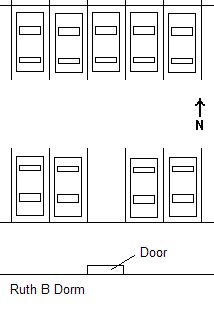 As you can see, the most coveted spot in the universe was open: the spot closest to the door. Now, maybe I could understand someone being excited to come back from buying cheap crap at Wal-Mart to find that parking spot open. But that’s not what happened. No fewer than five sophomores ran out of the dorm to their cars. At least three of them got into their cars, and two engines started. The one in the spot directly north of the open spot pulled out first and obtained the Holy Grail of parking spots. His car was no more than 15 feet closer to the building than it was before. He shut his engine off, got out, threw his fists in the air and yelled “Yes!” I smacked myself on the head in disbelief. His friends taunted him, saying that they would take the spot as soon as he went somewhere. He replied that he would avoid moving his car at all costs.
Assuming that this young man lived on the first floor of the building, rather than the second or third, and he was in the room closest to the door, he had to run a minimum of 50 feet and take 2 or 3 minutes out of his life to get a parking spot that was perhaps 15 feet closer to the door of his dorm building. Utter madness! Seeing this spectacle was nearly enough to alter my brain’s physical size and chemical makeup, giving me a nasty case of schizophrenia for which I have no genetic susceptibility, but alas, I fought these strange forces at work by sheer will.
This is not an isolated incident.
Now I live in Lincoln, home of the famous Huskers football team. Even though they’ve fallen on hard times, they’ve sold out every game for more than the past 30 years, and parking anywhere within a mile and a half of the stadium is a premium.
Now here’s the madness: people will go to the close parking spots the night before and pay the $5 or more parking fee. They then walk to wherever they’re staying overnight, whether it be home, a friend’s place, or a hotel room. Before the game starts, they walk back from that place to the stadium. And, after the game, they get the benefit of being close to the stadium and having to wait much longer for traffic. (Everyone loves to sit in traffic!) Yes, some people get picked up in another car and then dropped off at the game. But in either case, does it make any sense to park there? If you’re going to walk, just walk to the game and back to wherever you were staying. If you’re going to get dropped off, can’t they drop you off before the game and pick you up after the game?
I just get this terrible feeling, like a million voices crying out and then being silenced.
The only explanation for this behavior is that the parking spot has ceased to be a means to an end and has become the end in itself. That. Is. Neurotic.
It kind of makes me want to move to Germany, where absolutely no one is crazy or weird.
I’m not too well-versed in the insanity of other countries, aside from religious or political nuttitude that ends up killing people in places like Arabia, Ireland, East Europe, and other places.
In America, we have parking spots. But not just any parking spots. Oh, no. In America, only the best gets our attention. The best parking spots make us go crazy. The closest spot is like freakin’ nirvana, but with more beer and pizza (and without the mediocre grunge music).
My first inklings of this insanity came to me in my old job as a cart attendant at Target. I spent a lot of time in the parking lot at that job, and observed what I thought to be odd behavior. (Khorbin did the same job at the same store.)
Some people would park in the loading/unloading zone and leave the engine running, even if they were going to take a half hour or more. Regardless of what this does to your engine and your gas prices (they were around $1.50 at that time), it’s risking your car to thieves. Sure, Norfolk, Nebraska is a town of 23,000+, but it could still happen.
Some people would sit in their car and wait for someone with a close parking spot to pull out so they could take it. They would do this even if it took the other people several minutes to put their bags in the trunk and buckle the kids into their car seats.
This seemed bizarre to me even at that time. I had discovered that trying to find a good parking spot takes more time than it’s worth, especially when you have to wait for someone else to pull out (inevitably making their job more difficult in the process when you get close enough to exclude any usurpers). In addition, Winston was my pimpin’ ride and when you park far away you’re less likely to get dents. People with Corvettes know that, too, as I observed. And have you ever tried to park a 1988 Lincoln Towncar in a perpendicular spot when there’s a car on either side?

(Despite my utter disdain for the entire hip-hop/rap subculture, I must admit the coolness.)
It was clear to me that finding a close parking spot does not save time. So I assumed that it must be about walking distance, that Americans at large don’t like exercise. (HA! Puns make me chuckle.)
But then, in my senior year of undergrad, something happened to shatter any illusions of sanity in American parking practices. Here’s a pretty picture that I’m sure will win me some kind of award:
 As you can see, the most coveted spot in the universe was open: the spot closest to the door. Now, maybe I could understand someone being excited to come back from buying cheap crap at Wal-Mart to find that parking spot open. But that’s not what happened. No fewer than five sophomores ran out of the dorm to their cars. At least three of them got into their cars, and two engines started. The one in the spot directly north of the open spot pulled out first and obtained the Holy Grail of parking spots. His car was no more than 15 feet closer to the building than it was before. He shut his engine off, got out, threw his fists in the air and yelled “Yes!” I smacked myself on the head in disbelief. His friends taunted him, saying that they would take the spot as soon as he went somewhere. He replied that he would avoid moving his car at all costs.
Assuming that this young man lived on the first floor of the building, rather than the second or third, and he was in the room closest to the door, he had to run a minimum of 50 feet and take 2 or 3 minutes out of his life to get a parking spot that was perhaps 15 feet closer to the door of his dorm building. Utter madness! Seeing this spectacle was nearly enough to alter my brain’s physical size and chemical makeup, giving me a nasty case of schizophrenia for which I have no genetic susceptibility, but alas, I fought these strange forces at work by sheer will.
This is not an isolated incident.
Now I live in Lincoln, home of the famous Huskers football team. Even though they’ve fallen on hard times, they’ve sold out every game for more than the past 30 years, and parking anywhere within a mile and a half of the stadium is a premium.
Now here’s the madness: people will go to the close parking spots the night before and pay the $5 or more parking fee. They then walk to wherever they’re staying overnight, whether it be home, a friend’s place, or a hotel room. Before the game starts, they walk back from that place to the stadium. And, after the game, they get the benefit of being close to the stadium and having to wait much longer for traffic. (Everyone loves to sit in traffic!) Yes, some people get picked up in another car and then dropped off at the game. But in either case, does it make any sense to park there? If you’re going to walk, just walk to the game and back to wherever you were staying. If you’re going to get dropped off, can’t they drop you off before the game and pick you up after the game?
I just get this terrible feeling, like a million voices crying out and then being silenced.
The only explanation for this behavior is that the parking spot has ceased to be a means to an end and has become the end in itself. That. Is. Neurotic.
It kind of makes me want to move to Germany, where absolutely no one is crazy or weird.
Monday, October 31, 2005
Scalia Quote
From Justice Scalia’s dissent in Dickerson v. United States, 530 U.S. 428:
“The requirement that [constitutional rules, as modified by later decisions, must make sense] is the only thing that prevents this Court from being some sort of nine-headed Caesar, giving thumbs-up or thumbs-down to whatever outcome, case by case, suits or offends its collective fancy. . . .

“As far as I am aware, the public is not under the illusion that we are infallible.”
“The requirement that [constitutional rules, as modified by later decisions, must make sense] is the only thing that prevents this Court from being some sort of nine-headed Caesar, giving thumbs-up or thumbs-down to whatever outcome, case by case, suits or offends its collective fancy. . . .
“As far as I am aware, the public is not under the illusion that we are infallible.”
Subscribe to:
Posts (Atom)