Wednesday, November 30, 2005

Black Sabbath in the Hall of Fame

Black Sabbath is to be inducted into the Rock and Roll Hall of Fame in March.

That's not the real news. The real news is that up until now they weren't in it.

Seriously. Did they think that maybe this whole "heavy metal" thing will just blow over? They had to wait to be inducted at the same time as freaking Blondie, who started about ten years later than they did.
Artists are eligible to be inducted into the Rock Hall after at least 25 years have passed since their first record was released.
Oh, that explains it. . . . Wait, they released their first album in 1970. That means that they've waited ten years too long. Are they going to make Metallica wait until 2018? If I'm not mistaken, Randy Rhoads was already inducted. And he was Ozzy's guitar player starting about ten years after Tony Iommi. What exactly is the holdup?

“I Wish I Could Do That”

In high school some of my friends and I started a band. We sucked (and I particularly sucked on bass) but it was fun, and an excuse to hang out after school.
Anyway, one day we finished practicing and went downstairs. My friend’s dog was licking his genitals (some would say he was “on vacation”). The conversation went thus:
Friend X: “Man, I wish I could do that.”
Friend Y: “I don’t know . . . that dog looks pretty mean.”

I still laugh when I think about that. Just in case you don’t get it (and it won’t be funny now if you didn’t), the implication of Y’s statement was that he understood X to desire the ability to lick the dog’s genitals.

Tuesday, November 29, 2005

William L. Prossner Quote

Your lawyer in practice spends a considerable part of his life in doing distasteful things for disagreeable people who must be satisfied against an impossible time limit in which there are hourly interruptions from other disagreeable people who want to derail the train; and for his blood, sweat, and tears, he receives in the end a few unkind words to the effect that it might have been done better, and a protest at the size of the fee.

Monday, November 28, 2005

Ironic

Apparently, Ronald MacDonald is the Hamburglar.

Talking About Myself for a Change

When people use their blogs mostly to talk about themselves and their lives, it’s usually boring. So normally I eschew that in favor of more entertaining and educational ventures.

And this Friday I promise to post about a big subject in many people’s minds today: war.

But with my wedding coming up in about three weeks, I thought that just for once I could discuss where I’ve been and how I got here. It’s my blog, after all.

To save you a lot of time talking about what a dork I was as a kid (I have pictures to prove it, but not in digital format), or how cool I thought I was in high school wearing my fedora and driving around in my Towncar smoking cigars and listening to (*gasp*) Kid Rock, I’ll start at my college days.

The Early College Chapter

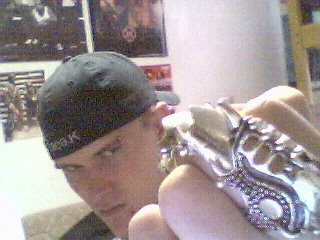
When I got to college I was already cool, as you can plainly see from this picture.

(This is the best excuse for a goatee I could come up with.)
That was taken my freshman year with my spiffy webcam, which I have never installed on my new computer. That year and the next I skipped a lot of classes, watched a lot of movies and played a lot of Starcraft. My usual day had me waking up at noon or one and finally going to sleep any time from three to six thirty in the morning.
I was very much into body modification.
Moving counterclockwise from bottom left: my first piercing in my lobe, given to me by my friend Adam, my second piercing which I gave myself in the bathroom of my dorm, and the cartilage piercing I got at Wal-Mart.

And finally, the eyebrow piercing I gave myself in my dorm room sophomore year.
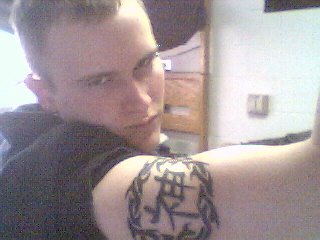
And let’s not forget my three tattoos. Here’s the evolution of one of them:

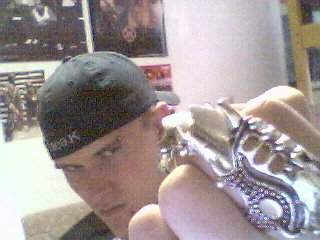
I was definitely a dork, as I am now, and probably a rebel. Check out this badass ring, or something, which my friends and I affectionately called the “Death Claw”:
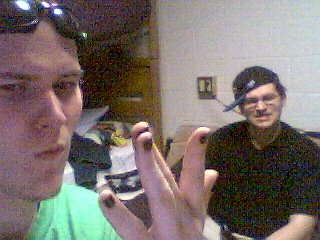
And let’s not forget the goofing around I did, this time with a guy named Dan.
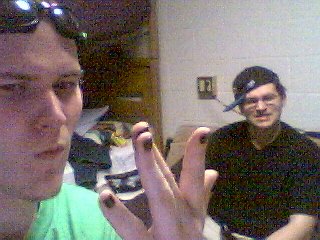
(Yes, I painted my fingernails black.)

The Walter Fisette Chapter
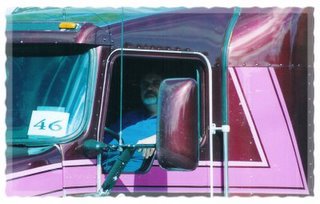

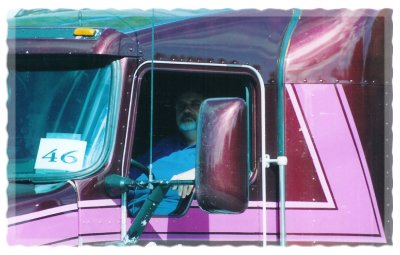
But that all changed when I started working for Walt. He had been in the moving business for thirty-some years, and he always had something to say about everything. He appreciated all kinds of people and could get along with anyone. I worked with him for two summers, and they were probably the best two summers of my life. We moved doctors, pastors, power company workers, soldiers, and even a cattle baron. We went to Albuquerque, New Mexico; Colorado Springs, Colorado; Billings, South Dakota; Iowa City, Iowa, and Manhattan, Kansas; among other places. It was hard work, but rewarding, to lift all kinds of heavy stuff, emptying a whole house, and then helping someone start anew. Walt in many ways convinced me to realize my potential and stop screwing around. By the way, in that picture he is driving in a parade in a truck for the Orphan Grain Train, a charity that helps a lot of people, mostly in Russia. He drove the first truck ever for that charity.

Over Thanksgiving break my junior year I was helping him with another move, this time in York, Nebraska. A day (or was it two?) before Thanksgiving, we were sitting in the truck waiting for it to warm up. I was lying in the top bunk trying to get some sleep before we left. And Walt was having a bad case of acid reflux, so he was waiting for it to subside before departing. He couldn’t get over how bad the pain was, and he thought he was going to throw up. He said, “Harold, get a bag, quick!” (Harold was a long-time helper of Walt’s.) After that he passed out and started gurgling. His wife Louise started administering CPR (she’s an RN) and Mike, another helper (Walt said he’s good for a day or two, but if you work past four or work him for more than two days he’s worthless), dialed 911. The ambulance arrived and took him away. I went home, with blind and complete faith in our medical professionals and the advancement of medical science. I got a call from Dennis (my dad’s best friend from high school and a dispatcher for Andrew’s Van Lines) a few hours later. He asked me how I was doing. I said I was ok. He said he thought I’d take it worse than that. It was then that he informed me Walt had died at the ripe young age of 52.

I’m not really sure what to say about that.

At the funeral, I cried. Clayton Andrew, the 90-some-odd-year-old owner of Andrew’s, stood up and talked about what a great, reliable guy Walt was, and how he will be missed. Other people stood up and talked about how he knew a lot of things and could talk your ear off, and about how he really cared about what he was doing and knew that he was working with people’s lives. Harold, the quiet-spoken farmboy, however goofy-looking he may be, looked nice in a suit. Louise handled it well, I think. I even met Walt’s mother and sister. His mother has the most beautiful German accent, and it’s rare to see someone that sad. His sister has Downs syndrome, and I don’t think she completely grasped what was happening.

Walt had a huge impact on my life. Not many people can say that about their boss at a college job. He’s certainly much better than the lying bitches who smoke every fifteen minutes and meth manufacturers that I worked for and with at the deli in Pac ‘N Save.

One last thing:
On the way from Seward (my college town) to Hadar, Nebraska, for Walt’s funeral, it was probably the most beautiful day I have ever seen. The ground was covered in pristine white snow and the trees were lovingly frosted by a benevolent God.

Finally, to My Bride-To-Be

I was already dating Laura at the time Walt died. She knew how hard it was for me.
She has continued to be a good influence on me in Walt’s stead. Just look at how much more clean-cut I am in the picture. She loves me, and I love her. She’s a good small-town Nebraska girl, and she’s smart. And most importantly, she loves dogs almost as much as I do. What more could I possibly ask for? Now she has her BSN and is working as an RN. She ultimately gave the suggestions that put me over the edge and made me decide to go to law school.

And now look at me.
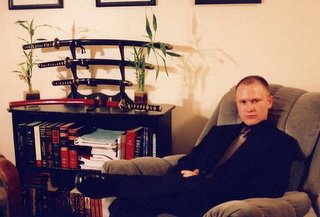
I’m all clean-cut and dressed up with nowhere to go. Of course, that’s because I took the picture after oral arguments for Legal Writing class. And check out the samurai sword set and the bamboo. And that amazing receding hairline! What could be sexier than a bald man in a suit wielding a katana in one hand and a legal textbook in the other?

Well, that’s it. I’ll try not to talk about myself for a while, if only to keep people coming back to the blog.

Wednesday, November 23, 2005

Hypnotize

I picked up the new System of a Down CD, Hypnotize yesterday. And I have to say, it's very good. It continues in their tradition of bizarre, eclectic styles and their highly relevant lyrics. They also continue to use nonsensical lyrics for the sheer sonic effect of those lyrics. The song that stands out the most so far is "Vicinity of Obscenity" because of the nice funk riff in there.

It is intended as the second CD in a Mezmerize/Hypnotize two-disc set. And in that vein, it's right up there with others such as the Smashing Pumpkins' Mellon Collie and the Infinite Sadness and Metallica's Load and Reload. The two mesh well, with no significant departures in style or production. And since "Soldier Side (Intro)" opens the first and "Soldier Side" closes the second, there is a beatufiul sense of closure when you finish listening to the pair. Incidentally, they would actually both fit on the same 80-minute disc.

Tuesday, November 22, 2005

Lawyer Advertising

The Florida Supreme Court isn't going to allow a law firm to use pit bulls as a mascot/advertising scheme/phone number. Read about it here, if you want.

Apparently they're also worried about lawyers being compared to sharks. Like that would ever happen. :)
So, apparenlty the First Amendment doesn't apply to lawyers.

Can I use a Terminator as a mascot? Or what about a ninja? A noble samurai warrior, perhaps?

Stupid Miranda Rules

Miranda v. Arizona excludes evidence of anything you say, while under arrest, until after the officers tell you that you have the right to remain silent. Doyle v. Ohio, to make this a real right, disallows prosecutors from commenting on the silence of a defendant who has been read his rights. But Jenkins v. Anderson, on the other hand, allows prosecutors to comment on a defendant’s pre-arrest silence when he has not been read his rights. And Weir v. Fletcher says that they can comment on your silence even after arrest, but before the warnings are given. So, before they read you your rights, you don’t have the right to remain silent, but you have the right to say anything you want (although it can be used to impeach you at trial). After they read you your rights, you have the right to remain silent, but anything you do say can be used against you.

Why does your right depend on whether they told you about it?
Why are the rights reversed (and ill-protected) upon receiving warnings?
Doesn’t this put people who know their rights at a disadvantage?

This stupid mosaic of law is brought to you by the politicians in cheap robes, and the number 9.

Monday, November 21, 2005

Giant Robots

Giant robots are really freakin’ cool. So much so that I can’t even put it into words. So I’ll have to make up a new one: spiffy-dynamitacularasticalesque. And even that word doesn’t completely capture the awe and majesty that giant robots inspire, because, well, it’s kind of a silly word. And there is nothing silly about giant robots.
I’ve always wanted my own giant robot, ever since my youth, when I watched Transformers, Robotech, and even the sub-par Gundam Wing. But that’s just the thing. You can take any show or movie, and add giant robots, and it’s at least 84% better (as studies have shown). This is particularly impressive when you realize that ninjas only make fiction 76% better, pirates 24%, and hobbits a mere 2%. Only Kurt Russell has a larger effect, making all fiction 91% better than it would have been without him.
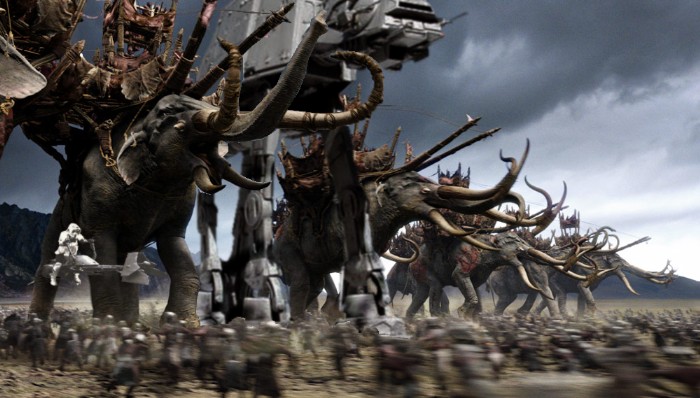
When I was in sixth grade, I read the BattleTech novels, and before that I even had a computer game based on that franchise. I also read the Robotech novels in the fifth grade (long before I saw the television series). Hell, I even watched a really crappy movie called Robot Jox, and, you know what? It was at least eighty-five percent better than it would have been without the giant robots. And let’s not forget the AT-ST’s and AT-AT’s of the venerable Star Wars trilogy. Or their short appearance in The Lord of the Rings: Return of the King.

Video games on the subject also capture our imagination, for example, the MechWarrior series (based on the BattleTech universe) and the Armored Core series.
Even today, in the early years of my adulthood, giant robots are still fascinating. I particularly recommend Neon Genesis Evangelion, a superbly written (and above-average animated) anime series. It combines giant robots with Biblical Apocalyptic themes (which have been known to make fiction 43% better, yet still failed to make Left Behind readable at all).

Let me know if I failed to mention any giant robot stuff that’s worth mentioning. I know about Nadesico but I’m not really familiar with it. Terminator and Ghost in the Shell don’t really count because the larger robots play a minor role.

What many people don’t know is the long history of giant robots. In Japan, for example, they have been a regular part of daily life for thousands of years, as this famous Hokusai painting illustrates:


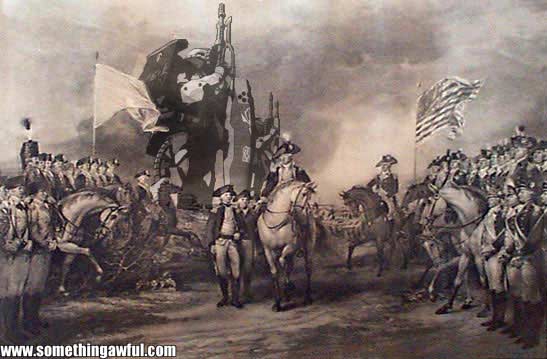
They’ve also been a big part of American history:


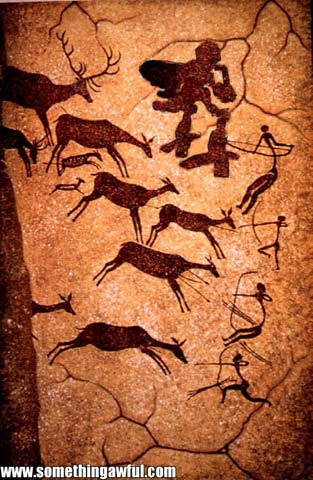
But the history goes back even further, as you can see from this primitive cave painting of a Timber Wolf OmniMech (Mad Cat to you Inner Sphere dogs):


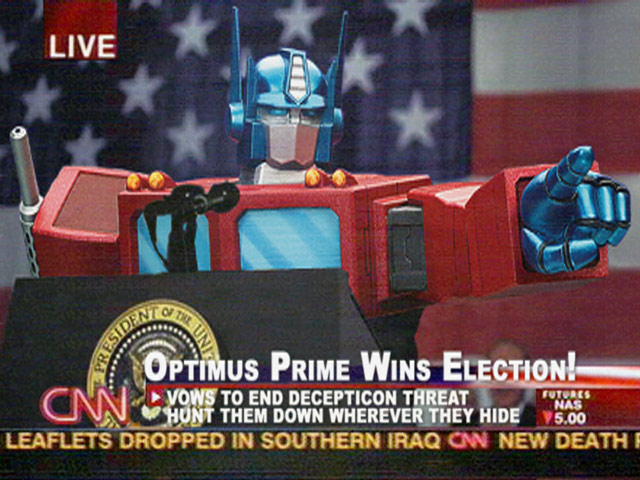
Today, giant robots don’t seem like such a big deal. They’ve become as American as the Teenage Mutant Ninja Turtles. We even elect them to public office!


Now, to get your giant robot noticed, you have to add some extras. Pimp them out, to use the vernacular.


Where do we go from here? Do we make bigger (dare I say gianter?) robots than before? Or do we concentrate instead on regaining the long-lost Jedi powers that humans once had? The sky’s the limit now that all the world’s problems have been solved.

(I make no pretense that any of these pictures are my own. They have been lifted from Fark and Something Awful.)

For more robot-related (some giant, some not) information, look here and here.

Thus ends a post about longed-for childhood dreams.

Friday, November 18, 2005

Where Did Tort Reform Go? or, Torts Are Funny

Tort reform was a big part of Bush’s original campaign. After 9/11, however, it seems to have disappeared off the map entirely, while Social Security reform is probably just recharging its power scooter. Perhaps Bin-Laden and his flunkies sat around and said, “You know, American tort law is really screwed up. Let’s distract them, and eventually it will bring down their economy.” Far-fetched? At least as much so as a world with a jet pack in every home (which would be pretty sweet), but maybe it’s not entirely off the mark.

The Purposes of Tort Law

Tort law is intended as a method to make someone whole again when they are injured. If, for example, Tortfeasor sits next to you in class, and he kicks you in the shin (like the bastard he is), you will be injured. (Thanks Vosburg v. Putney.) Assume your leg breaks. You have a doctor bill, and tort law makes Tortfeasor foot the bill. Assume also that you are a field goal kicker for a professional football team, and the season opener is tomorrow. Your contract is not very good for you, so you miss out on some pay. Tortfeasor will also have to pay all of this back. Tort law doesn’t care that Tortfeasor works in a factory for $40K a year and you still make $1mil even after the injury. But it does do one thing right: you are obligated to try to find comparable work to mitigate the damages. There probably is no comparable work to playing football, but let’s assume you work at McDonald’s anyway for $10K (and you’re lovin’ it). Your damages from lost wages will be reduced by that amount.

The Problems with Tort Law

Of course, I have a problem with the current state of tort law and some of the assumptions it makes. Take the hypothetical situation of X and Y. (Any resemblance to actual persons, living or dead, is purely coincidental.) X and Y are driving their cars. X and Y are both talking on their cell phones. Y hangs up his phone, and ten seconds later X and Y collide. X will probably be found negligent because he was talking on his phone, and so he will have to pay for Y’s damages. But this is about as fair as a fight between Kurt Russell and Metal Gear Ray. The Metal Gear doesn’t stand a chance. Both of these guys were talking on their cell phones, as many people do when they’re driving. It was purely coincidence that X was still talking when the accident happened. We’re all negligent every day. Hell, I’ve seen my torts professor talking on her cell phone while driving. Not to minimize the victimization of the injured party, but the other party is also a victim of the system. (Although, I do have to admit that a kind of social insurance program would be at least equally as reprehensible.)

Now assume Y became a quadriplegic. X will have to pay Y’s lost wages for Y’s full life expectancy. Recall that the purpose of tort law is to make the injured party whole again. Let’s look at it this way:
Before the accident: Y worked for his wages.
After the accident: Y gets free money for just sitting around and watching TV!
Let’s not forget pain and suffering damages. Yes, I’m sure that pain and suffering is worth something, but juries tend to inflate it unrealistically, to the point that Y can buy a nice big screen TV and a mansion to ease his suffering.
And there will also be loss of enjoyment, because now Y will never again know the pure joy of scratching an itch, or of playing hopscotch. These damages are similarly difficult to quantify.

Now, let’s assume that Y died in the accident. The executor of his estate gets to sue X for Y’s lost wages as well as other things. Funeral costs are one that particularly irks me. Y would eventually have died and had a funeral anyway. If anything, Y is actually saving money on funeral costs, because they go up annually as surely as Santa Claus delivers presents or George Lucas ruins Star Wars with a new edition every year. (I heard that next time he’s going to change Leia’s slave girl outfit into a wookie costume.)
Oh yeah, and Y’s wife also gets to sue for loss of consortium.

Let’s take one final hypothetical, more related to the topic of tort reform as Bush saw it. Hypothetically, let’s just say there is a car manufacturer. Let’s call it Ford, just for fun. Also, let’s assume that they built a car that explodes when it’s hit from behind. Let’s just call that car a Pinto. Let’s further assume that Ford decides not to recall said vehicle. Now, let’s assume that a guy named Poor Bastard suffers third-degree burns in the accident and dies. His next of kin, Lucky Bastard, sues Ford. In many states, not only will he get all of the damages I’ve set out above, but also punitive damages, assuming that the jury decides Ford’s conduct was egregious enough. This is where Ford’s wealth comes in. Let’s say, for the sake of argument, that this is a multi-billion dollar company. The punitive damages, instead of being designed to make the victim whole again, are designed to be, well, punitive. So the jury thinks a $100million award might punish Ford a bit. And Lucky Bastard, being no one in particular except for a guy whose brother bought a damn ugly car, gets all that money. He will, of course, by a Volvo with that money. Yeah, right.

Conclusion

Well, the only conclusion I can make is that tort law starts out with an excellent premise, and then turns the tortfeasor into the real victim. Most of the time it’s just somebody who was a little careless, as we all are. And he better hope that he makes twice as much at his job as the other guy, otherwise he won’t have any money left for himself. And, of course, we can’t forget all the Lucky Bastards out there who get a windfall profit out of the deal.